
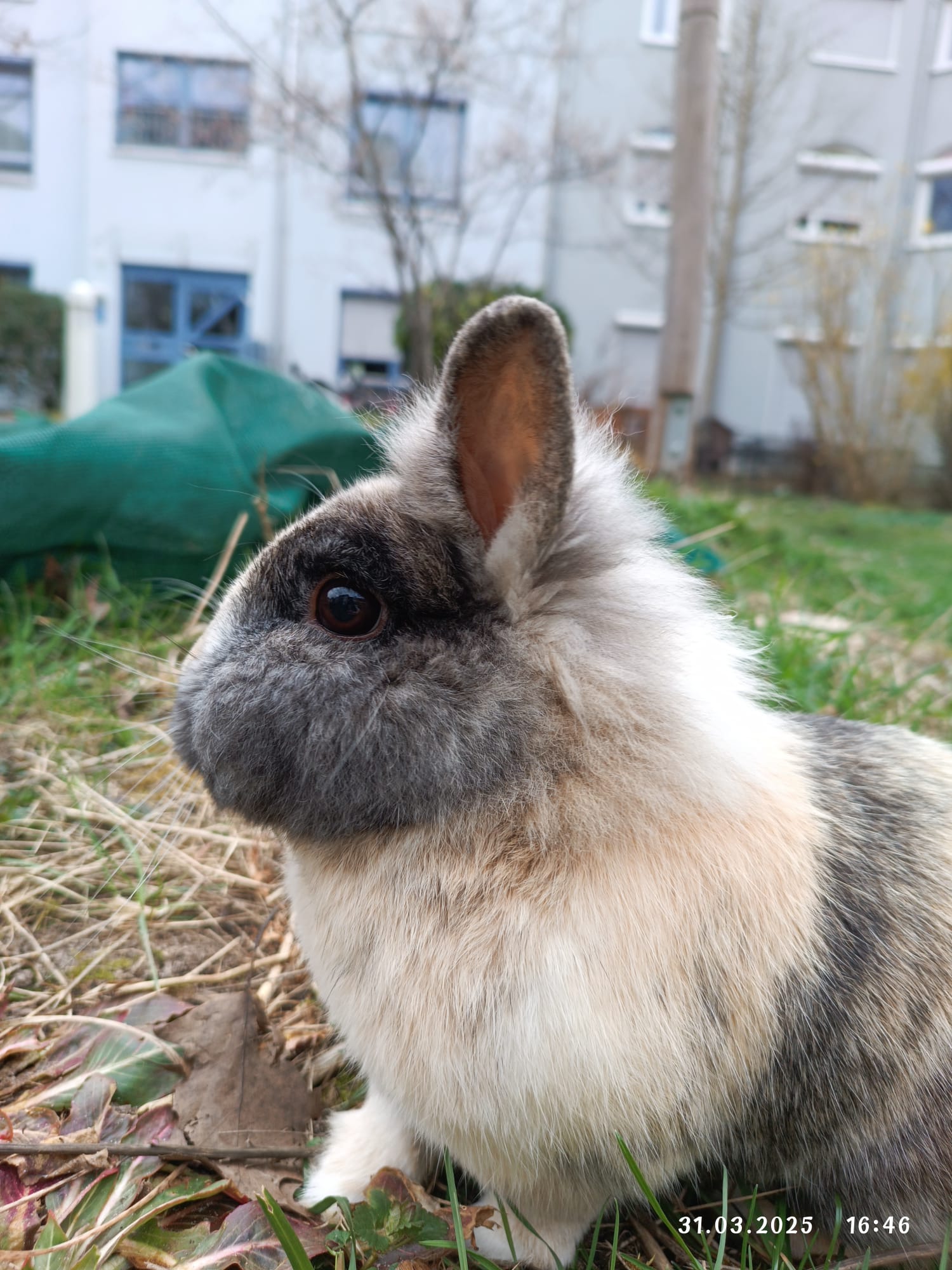
I hit the brakes. Sylvester was sitting in front of me.
Luckily, he wasn’t dead. He just looked like he was pretty pleased with himself.
And yet I had actually thought he was a rabbit who was content with a hutch, an enclosure, and a black female companion named Nora.
Before the Pentecost break, Sylvester began to take an interest in freedom. Up until then, our colorful rabbit had regularly shown that a hutch was more of a non-binding suggestion than a permanent home for him. But suddenly, that wasn’t enough for him anymore. More and more often, he’d be sitting in the courtyard in the mornings—and sometimes I had to slam on the brakes as I pulled out of the underground parking garage.
His companion, Nora, was quite different. The black rabbit preferred the safety of her hutch to the dangerous world outside and continued to indulge her nesting instinct, which kept her trapped in a pointless cycle of repetition as she lived with a neutered rabbit.
Our rabbit hutch was located in the neighborhood’s communal courtyard, which couldn’t be seen from the street. That was probably for the best. After all, a rabbit hutch in the middle of a courtyard only looks idyllic if you don’t look too closely. The enclosure was covered by a net that was originally meant to prevent the rabbits from exploring their surroundings. Over time, however, the net had developed a few holes. Not many. But enough. There were also bars everywhere. They enclosed the pen and gave the overall impression that, when it was built, great effort had been made to keep two small animals as reliably as possible from escaping to freedom. Grass hadn’t grown on the floor of the pen for a long time. Sylvester and Nora had taken care of that thoroughly. What remained were mostly weeds that even the rabbits apparently considered inedible. Until recently, a birch tree had provided a touch of nature. However, it had fallen victim to the gnawing habits of its inhabitants and eventually had to be cut down. The rabbits had thus successfully eliminated not only the grass but also the only tree in their little kingdom.
Actually, everything was ready for the Pentecost break. The vacation was booked, the suitcases were almost packed, and the neighbors were taking turns feeding the rabbits.
Two days before departure, Sylvester had disappeared again.
His favorite hiding spots were empty. So the neighbors were given a slightly modified set of instructions: This time, the rabbit didn’t need to be fed—it needed to be caught. That was going to be a laugh.
Things were quiet for a few days. Then Frida, our children’s friend, got in touch. She had found Sylvester on a website for stray animals. The posting was already a few days old, though.
Shortly after that, she got back in touch.
Sylvester had been found.
A group of college students had picked him up, taken him to the vet, and then dropped him off at the animal shelter.
I contacted the animal shelter. At first, they weren’t too thrilled that we apparently hadn’t kept our rabbit safe enough. I received a detailed introduction to species-appropriate rabbit care, animal welfare, and the responsibilities that come with being a pet owner.
Terms such as guidelines, secure storage, and fee schedule were mentioned.
By then, I had the feeling that I wasn’t on the phone because of a runaway rabbit, but because of a moderately serious violation of German rabbit lore.
But all I really wanted to know was when I could pick up Sylvester again.
That wasn’t quite so easy, though.
The animal shelter charged a flat rate of eight euros per day for boarding. Since Sylvester was expected to stay there until the end of the Pentecost vacation, I started doing the math.
About a hundred euros.
For a rabbit that had treated itself to a few days of freedom.
To be continued